
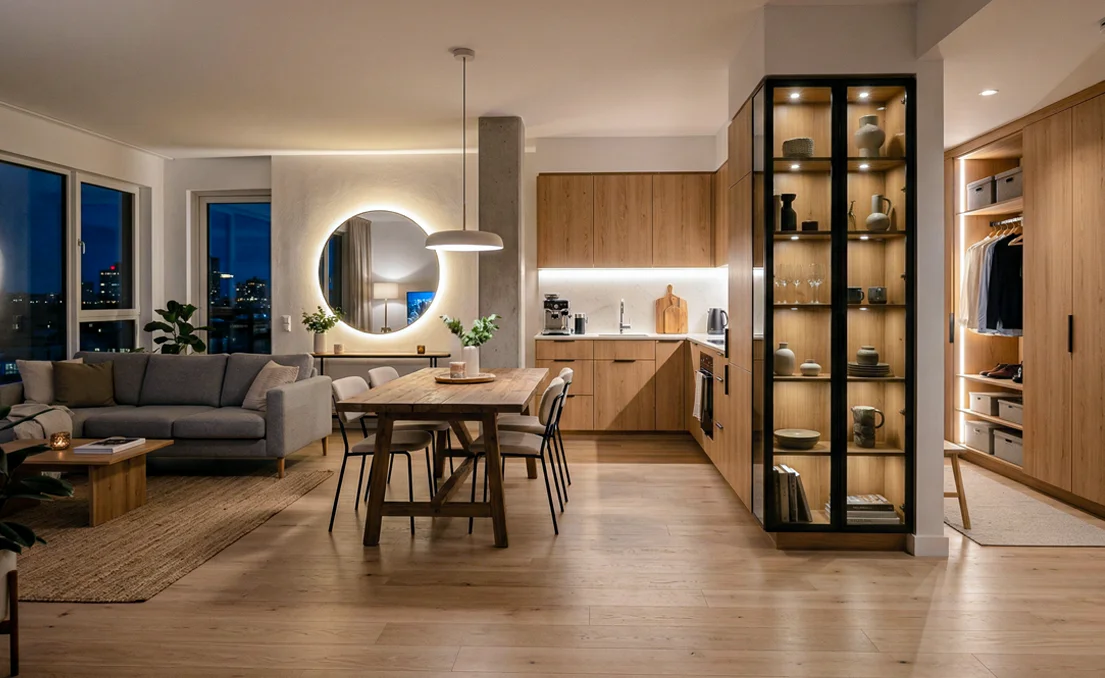
LED lighting in furniture is no longer only decorative. Today it also has a practical role. It makes it easier to use a kitchen, wardrobe, or bathroom, and at the same time improves the overall look of the interior. Well-chosen lighting can completely change how furniture is perceived and make a room feel more comfortable.
People who plan this type of lighting for the first time often wonder what to choose. The market offers LED strips, light bars, small lamps, and spotlights. Each option works best in different places, so it is worth thinking about a few basic questions before making a decision.
5 questions worth asking before choosing
Before selecting a specific type of lighting, it helps to define your needs. This makes it easier to match the lighting to the furniture and avoid random choices.
1. What will the light be used for?
Think about whether the light should mainly highlight the furniture or help with everyday tasks. Decorative lighting is usually softer, while work areas need stronger light.
2. Where will it be installed?
The location matters. Lighting under kitchen cabinets, inside a wardrobe, or next to a mirror often requires different solutions.
3. Should the light be visible or hidden?
LED strips are often hidden so that only the glow is visible. Spotlights, in contrast, remain visible and become part of the furniture.
4. How strong should the light be?
A kitchen countertop needs stronger lighting, while a shelf or display cabinet may only need a gentle glow.
5. How easy should the installation be?
Some solutions can be installed in minutes, while others require drilling or preparing space in the furniture.
Answering these questions helps narrow down the choice between LED strips, light bars, and spotlights.
LED strips: when they work best
LED strips are one of the most popular options for furniture lighting. They are flexible, very thin, and can be fitted into almost any space.
One of their biggest advantages is that the light source can be hidden. Strips are usually installed under cabinets, inside aluminum profiles, or in furniture recesses. Because of this, only a smooth line of light is visible.
LED strips work especially well in places such as:
- lighting the kitchen countertop under cabinets
- illuminating shelves and display cabinets
- lighting inside wardrobes and walk-in closets
- decorative lighting in living room furniture
It is important to remember that a strip alone is not enough. It also needs a power supply, a switch, and often a profile that improves appearance and helps dissipate heat, especially if it is made of aluminum.
LED strips also allow you to choose different light colors. Warm, neutral, and cool tones can be selected depending on the style of the interior.
Light bars and small furniture lamps: simpler solutions
If quick installation and ready-made products are important, LED light bars or small furniture lamps can be a good choice.
Light bars are closed fixtures with LEDs already installed inside. Usually, they only need to be attached to the furniture and connected to power.
Their advantages include:
- fast and simple installation
- neat and finished appearance
- no need to select many separate components
LED light bars are often used under kitchen cabinets, above worktops, or inside cupboards. Many models include built-in touch switches or motion sensors.
Small furniture lamps work in a similar way. The main difference is their shape and mounting style. They are usually compact and discreet, which makes them suitable for shelves, cabinets, and wardrobe interiors.
Spotlights: when they are a good option
Spotlights are small fixtures installed directly into the furniture board. In most cases, a hole must be drilled to mount them.
This type of lighting produces more focused light than LED strips. Because of that, it works well when a specific place needs stronger illumination.
Spotlights are commonly used in:
- display cabinets and glass cupboards
- decorative shelves
- wardrobes and dressing rooms
- above mirrors
- under upper kitchen cabinets
Their advantage is the clean look. After installation, the fixture becomes a part of the furniture and blends well with the design. The focused beam of light can also highlight decorative objects.
The main drawback is that installation can be slightly more demanding and often needs to be planned earlier.
Typical lighting combinations in different spaces
In practice, furniture lighting rarely uses only one type of lamp. Different solutions are often combined to achieve a better effect.
Kitchen
LED strips or light bars are commonly installed under wall cabinets to illuminate the countertop. Spotlights can also be added in glass cabinets.
Wardrobe or walk-in closet
LED light bars with motion sensors work well inside wardrobes. The light turns on automatically when the door opens. In larger closets, spotlights can also be installed in shelves.
Mirror
Lighting near a mirror should evenly illuminate the face. Light bars placed above the mirror or on its sides usually work well. In bathroom furniture, small spotlights are also sometimes used.
Well-chosen LED lighting makes furniture more functional and visually appealing. The best approach is to first decide where the lighting will be installed and what effect you want to achieve. After that, it becomes easier to choose between LED strips, light bars, or spotlights.