
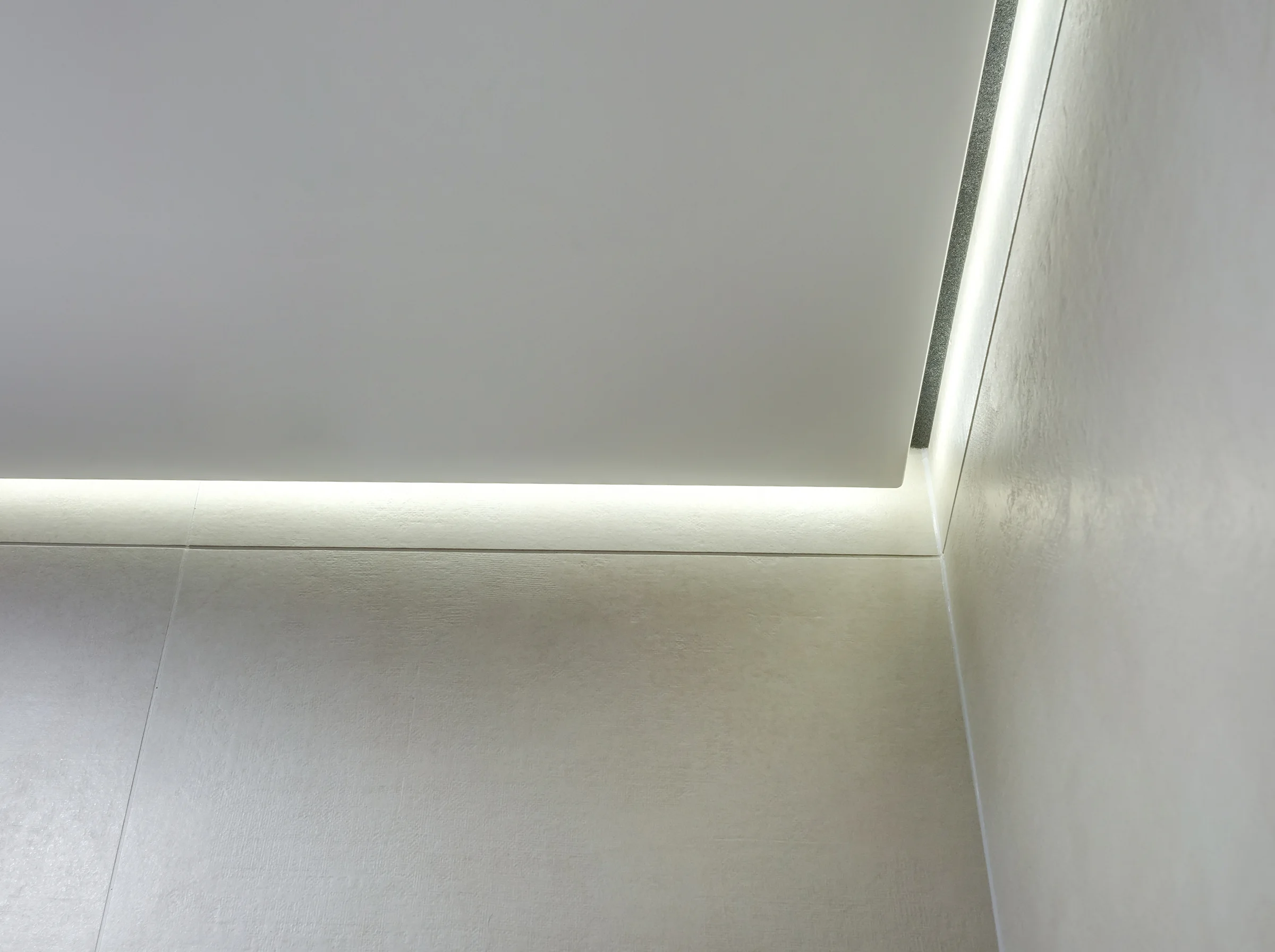
Why an LED strip shines unevenly even though everything is new
At first glance, the installation looks perfect. A new LED strip, a suitable power supply, everything connected according to the instructions. But once the light is turned on, disappointment appears. The beginning shines brightly and evenly, but the farther along the strip you go, the weaker the light becomes. At the end, the difference is already clear and hard to accept.
This does not mean the product is defective. In the vast majority of cases, the issue is voltage drop. This is a natural effect that occurs whenever current has to travel a certain distance. The problem begins when that distance is too great or when the installation was designed without taking a few basic rules into account.
What voltage drop looks like in practice and why it is visible?
Voltage drop at the end of an LED strip is simply the loss of part of the electrical energy as it flows through the wires and the conductive paths of the LED strip. Every conductive material has some resistance. Even if it is small, over longer distances it starts to matter.
In practice, this means that the LEDs closest to the power supply receive a higher voltage than those at the end of the strip. And because LED brightness depends directly on voltage, the difference becomes visible to the naked eye.
This often shows up not only as lower brightness. With warm light colors, the end of the strip may appear more yellow or dimmed. With cool light colors, the effect may look like a slight graying.
The point at which the problem starts to become noticeable
Not every installation will have this problem right away. Short sections, for example up to two or three meters, usually work without issues.
In practice, even 3, 4, and sometimes 5 meters of a single-color strip may work properly, depending on its power. In the case of RGB strips, especially those with a high LED density, for example 600 LEDs/m, voltage drop may become visible already at lengths of around 3 meters, but generally problems begin with longer lines of light, especially above five meters.
However, the limit is not fixed. It depends on several factors. With a lower-power strip, the effect may appear later, while with a more powerful one it may show up much sooner. That is why it is not worth relying only on length. It is better to understand what exactly influences this effect.
The effect of strip power on lighting uniformity
The higher the power of the LED strip, the more current has to flow through it. And the greater the current, the greater the losses along the way. This is a very simple relationship, but it is often overlooked when choosing lighting.
For example, a strip rated at 4.8 W/m will be much less demanding than one rated at 14.4 W/m. In practice, this means that at the same length, the more powerful strip will begin to shine unevenly sooner.
That is why, when planning lighting, it is worth looking not only at brightness, but also at how a given strip will behave over a longer run.
The difference between a 12 V installation and a higher-voltage system in everyday use
One of the most common ways to improve the situation is to power the strip from both ends. This means supplying voltage both to the beginning and to the end of the section.
It is important to maintain the correct polarity. Incorrect connection may cause improper operation of the strip or damage it.
12 V strips are more prone to voltage drop. This is because at a lower voltage, a higher current is needed to achieve the same power. Higher current means greater losses.
Strips operating at a higher voltage work more stably over longer sections. The current is lower, so the voltage drop is also smaller. In practice, this means more even lighting and less risk of problems.
That is why, for longer lines of light, choosing a higher voltage is simply the safer option.
| Feature | 12 V system | Higher-voltage system |
| Recommended max. length (single-sided power) | approx. 5 meters | approx. 10 meters |
| Current intensity (at the same power) | High (greater losses and heating) | Low (more stable operation) |
| Main application | Short sections, furniture, automotive | Suspended ceilings, long lines of light |
| Susceptibility to voltage drop | High | Low |
How do digital LED strips react to voltage drop?
Digital LED strips are a special type of lighting strip in which each LED or small group of LEDs can be controlled separately. This makes it possible to create animations, lighting effects, and changing patterns instead of one color along the entire strip.
In their case, voltage drop does not show up only as weaker light at the end. The problems are more visible and can affect how the effects work. The final sections of the strip may shine in a different color than intended, the animations may become less smooth, and sometimes random color changes appear.
This happens because, in addition to power, a control signal is also transmitted, and it is sensitive to installation quality. That is why with digital strips it is even more important to divide the setup into shorter sections, use proper power supply, and choose good wires. This ensures that the lighting effects look as intended along the entire strip.
The importance of wires, which is often underestimated
Many people focus on the strip itself and the power supply, while completely overlooking the wires. In fact, they are very often what makes the problem worse.
If the wire is too thin, it creates more resistance. This causes an additional voltage drop before the current even reaches the strip. As a result, even a well-chosen strip may shine unevenly.
In practice, this means that for longer sections you cannot use random cables. The wire cross-section should match the length and the load. The larger the installation, the larger the cross-section should be.
This is one of those elements that is not worth saving money on, because the effects are visible immediately.
Why does the length of one section matter so much?
A natural temptation is to connect one long strip to avoid joints and make installation simpler. Unfortunately, that is exactly when the greatest risk of problems appears.
Each additional meter of strip is extra distance the current has to travel. And every such distance means additional losses. That is why, instead of one long line, it is better to think of the installation as a set of shorter sections.
Dividing it into sections reduces the distance over which the current flows and therefore reduces voltage drop. It is a simple solution that gives very good results.
Powering from both ends as a practical solution
One of the most common ways to improve the situation is to power the strip from both ends. This means supplying voltage both to the beginning and to the end of the section.
This way, the current does not have to travel the entire length in one direction. Instead, it is distributed more evenly, which significantly improves brightness at the end of the strip.
In practice, the difference is very clear. A strip that previously shone unevenly can look like a completely new installation after this type of connection.
This solution does not require major changes, and it often eliminates the problem completely.
Dividing the installation into smaller sections and its effect on the final result
An even better approach is to divide the installation into several independent sections. Each of them has its own power supply, so it works under optimal conditions.
Instead of one section 10 meters long, you can use two 5-meter sections or even more shorter parts. Each of them will shine evenly, without visible voltage drop.
This approach is especially important in projects where appearance matters, for example in kitchens, walk-in wardrobes, or decorative lighting.
Installation mistakes that most often cause complaints
In practice, most problems result from repeated mistakes. The first is powering a long strip from only one side. This almost guarantees uneven lighting.
The second common mistake is using wires that are too thin. Even if the installation works, the visual effect is far from what was expected.
The second common mistake is using wires that are too thin. Even if the installation works, the visual effect is far from what was expected.
It is also common to see a 12 V system used in places where a higher voltage would work much better. This is a decision that is difficult to fix later without modifications.
How to think about an LED installation to avoid problems from the start?
The best results are achieved when the installation is planned before assembly. It is worth looking at it not as one product, but as a complete system.
You need to consider the length of the sections, the strip power, the way the wires are routed, and the power injection points. Only the combination of these elements gives a predictable result.
A well-designed LED lighting system shines evenly along its entire length, whether it is two meters or ten. And most importantly, it does not create problems after installation.
Light that looks good only at the beginning is a warning sign
If an LED strip shines clearly brighter at the beginning than at the end, it is a sign that something was overlooked during the design or installation stage. It is not worth ignoring, because the problem will not solve itself.
The good news is that in most cases it can be fixed easily. Sometimes it is enough to change the power supply method, sometimes to add a wire, or divide the installation into sections.
The most important thing is to understand the cause. Once you know where the voltage drop comes from, eliminating it becomes simple and predictable.